
September 2026
WARREN, Ark. — Clint Horn, 54, didn’t start his career in logging. After studying statistics and earning forestry degrees from Mississippi State and Penn State, Horn went to work in procurement in Arkansas. He started his own company, Timber Logistics, to buy timber, and later added company logging crews to the business. Today, Horn fields two crews and several contractors.
Inside This Issue
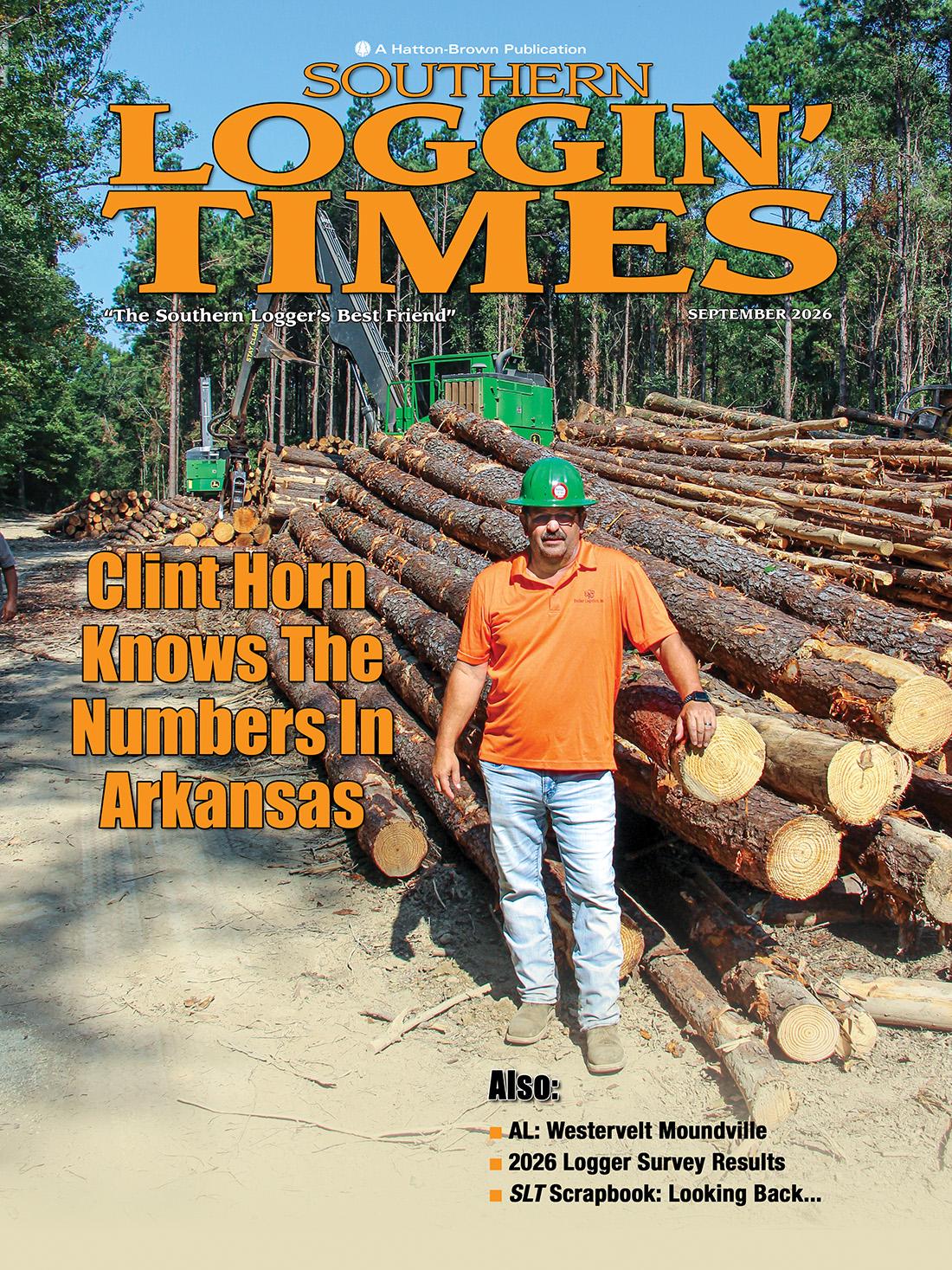
COVER: Woods Factory
WARREN, Ark. — Clint Horn, 54, didn’t start his career in logging. After studying statistics and earning forestry degrees from Mississippi State and Penn State, Horn went to work in procurement in Arkansas. He started his own company, Timber Logistics, to buy timber, and later added company logging crews to the business. Today, Horn fields two crews and several contractors.
Article by Patrick Dunning, Associate Editor, Southern Loggin’ Times
SOUTHERN STUMPIN': Meet David Livingston
For those who don’t know, David Livingston is the Executive Director of the Mississippi Loggers Assn.; he is also an active advocate for loggers at the national level through his involvement with the American Loggers Council. Southern Loggin’ Times recently had a conversation with Livingston about his career in the forest products industry and about the state of the industry today, focusing on the rash of pulp/paper mill closures and the influx of cheap fiber from Brazil.
Major Revamp
MOUNDVILLE, Ala. — Not long after Westervelt Lumber had finished building its greenfield sawmill in Thomasville, Ala., company officials looked north to further revamp its 30-year-old flagship Moundville sawmill. In recent years the Moundville sawmill site had received extensive upgrading to its timbers mill (the small log line) and marginal improvements to what’s called the large log line. The operation continues to run an older headrig/resaw line or the grade log line.
Article by Ford Boswell, Contributing Editor, Southern Loggin’ Times
Hard Hit
Once again, Timber Harvesting magazine (the big brother to Southern Loggin’ Times and another Hatton-Brown publication) took the pulse of the forest supply chain’s logging segment with its 2026 Logger Survey; a version of this survey report also appeared in the July/August 2026 issue of TH. Although this was a national survey, it turned out that nearly 60% of the responses (113 out of 197) came from logging companies operating in Southern states.
Article by Dan Shell, Senior Editor, Southern Loggin’ Times
FROM THE BACKWOODS PEW: Noah, the Beavers Are Eating a Hole in the Ark!
There are those times when it seems you are in the middle of a storm, maybe even surrounded by the wasteland. You’re holding on tight as your ship is rocking back and forth. Your faith is taking a beating. You’re holding on to trust, and maybe you can make it to the other side… and then you hear it: a shrill cry echoing through your little ship, and trust and faith seem to disappear. You hear it again, knowing it is not a dream, but yet another crisis. Will they ever stop?
INDUSTRY NEWS ROUNDUP
- Lumber Manufactory Opens 1st Sawmill
- Timber Theft Charges Made
Woods Factory
Timber Logistics makes most of tightening south Arkansas markets.
Article by Patrick Dunning, Associate Editor, Southern Loggin’ Times
WARREN, Ark. — Not everyone who owns a logging business follows the same trail to a career in the woods. Take, for instance, Clint Horn, 54, owner of Timber Logistics, Inc. His path started with a bachelor’s degree in forestry from Penn State, followed by a master’s in forest science from Mississippi State, on top of a minor in statistics. He went to work as a procurement forester for the Potlatch lumber mill in Warren, Ark., where he spent four years learning timber and lumber market dynamics firsthand.
In 2004 Horn bought a wood yard and established his own company, Timber Logistics. In 2009, he added fuel-chip production and logging. “We got into logging because we were having a hard time with contract crews being consistent,” he explains. “We started our own crew to accommodate moving our own wood.”
Now, 22 years later, the company handles 100% of its own purchased stumpage with two crews from its Warren headquarters. One is a dedicated chipping operation, and the other was converted to roundwood earlier this year. Horn oversees several contract crews as well. “Historically we do a lot of thinning and chipping in south Arkansas because there’s a need for it,” he says. “We get a lot of calls from folks wanting us to thin their tracts; it’s something we are known for.”
Operations
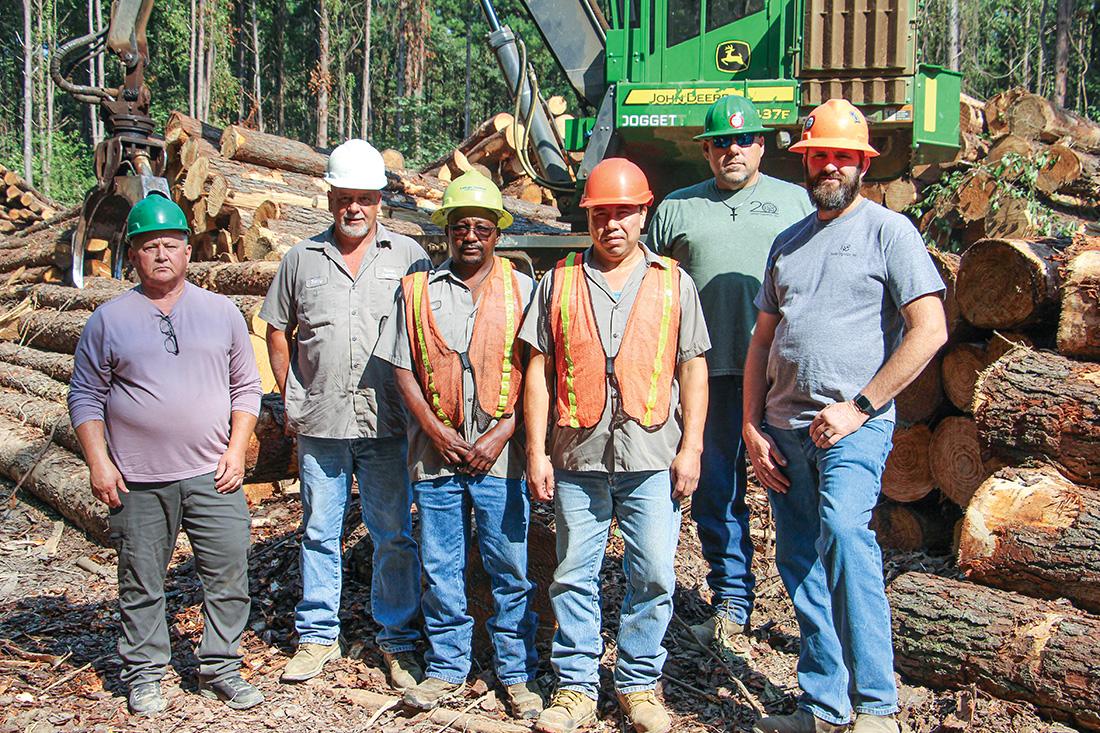
When Southern Loggin’ Times visited Timber Logistics in August, the roundwood crew was conducting a first thinning on 120 acres in Calhoun County for Superior Pine, a Georgia-based timber investment group. Timber Logistics’ operations manager Derek Adair, 43, says this flatwoods tract was previously pasture that was later planted in pine. Half of it was thinned once, years ago; the rest had never been touched. The 40-acre block currently being harvested is a true first thinning, though timber here is pushing 30 years old.
Each set is placed in an optimal location to minimize skids, keep production high and fuel costs down, and hold soil disturbance to a minimum. The cutter operator harvests every third row on this first thinning to protect the residual stand and help the remaining timber grow better. “Each management plan differs depending on the tract and client,” Adair explains. “On this particular job, because the timber is so mature, we’re doing a first thinning, every third row, to keep from disturbing the thinning rows. It helps the timber grow better and looks better overall.”
Describing the thinning prescription, he continues, “Our cutter operator is experienced and does a wonderful job in any situation. First pick is your undesirables, forks and crooks, and the second thinning is for spacing. Those are the parameters we use to approach this tract, and we do it right even when it doesn’t benefit us.”
Have A Question?
Send Us A Message