
Arkansas Group Receives USDA Bottomland Grant
Dr. Homer Wilkes, Under Secretary for Natural Resources and Environment at the U.S. Dept. of Agriculture (USDA), met with faculty from the University of Arkansas at Monticello (UAM) and the Arkansas Forest Resources Center (AFRC) of the University of Arkansas System Div. of Agriculture housed at UAM to award them a grant for $3.7 million. The meeting took place at Five Oaks Ag Research and Education Center in Humphrey, Ark., where part of the work for the project will be conducted.
The grant provides funding for USDA Partnerships for Climate-Smart Commodities projects, which are aimed at supporting sustainability in agriculture. AFRC at UAM is the lead on the project and will partner with the University of Arkansas at Pine Bluff (UAPB) and Texas A&M University (TAMU), as well as with recruited landowners. Dr. Nana Tian, assistant professor of natural resources economics and policy at UAM, developed the proposal for the grant and will serve as the project director.
The project will support small and underserved landowners in the river-influenced forest regions of Arkansas to develop and harness climate-smart commodities from restoration of the region’s hardwood forests. Bottomland hardwood forests have shown high potential for producing climate-smart commodities including carbon sequestration and storage, wood products, wildlife and other ecosystem services. Despite their importance, 70% of bottomland hardwood forest areas have been lost in the past 100 years.
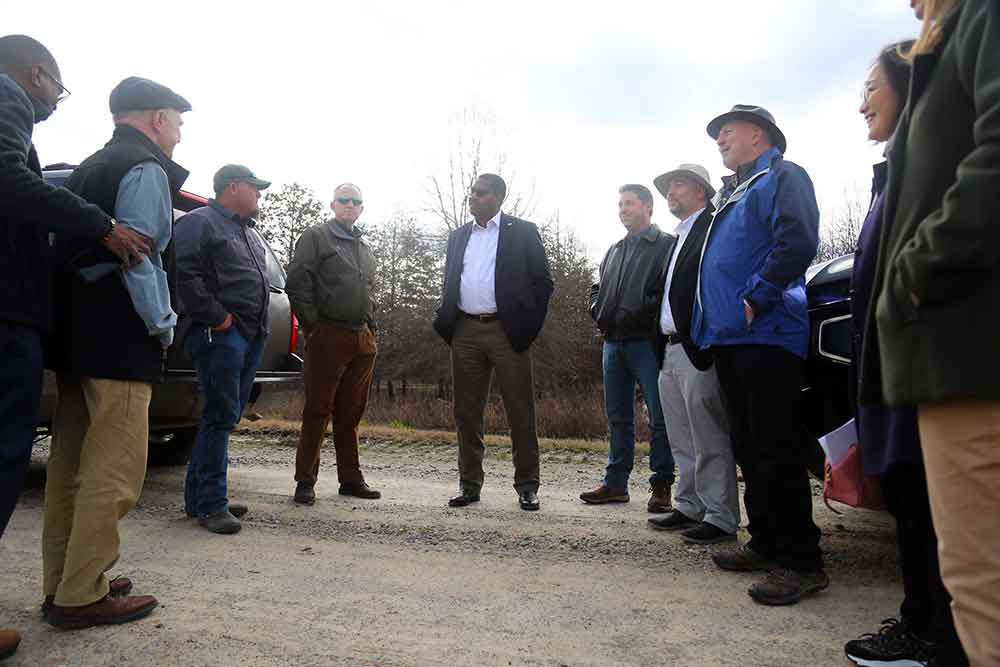
USDA Undersecretary for Natural Resources and Environment Homer Wilkes, center, visits with Division of Agriculture faculty at a research site in Humphrey, Arkansas. Wilkes visited the site on Dec. 16 to announce a $3.7 million grant for research in the Southern Bottomland Region. (Division of Agriculture photo.)
Latest News
Economist Says Future Looks Good For Southern Forest Industry
At least one economist and a local timber products manufacturer see a bright future for the Southern forest industry. Lynn Michaelis, president of Strategic Economic Analysis, told participants at the Georgia Forestry Association conference last month that the next 10...
Kudzu That Ate U.S. South Heads North As Climate Changes
As the climate warms, the vine that ate the U.S. South is starting to gnaw at parts of the North, too. Kudzu, a three-leafed weed first planted in the U.S. more than 100 years ago for the beauty of its purple blossoms, has been spotted in every county in Georgia,...
Have A Question?
Send Us A Message