
Felled Tree Strikes Crew Cab Truck
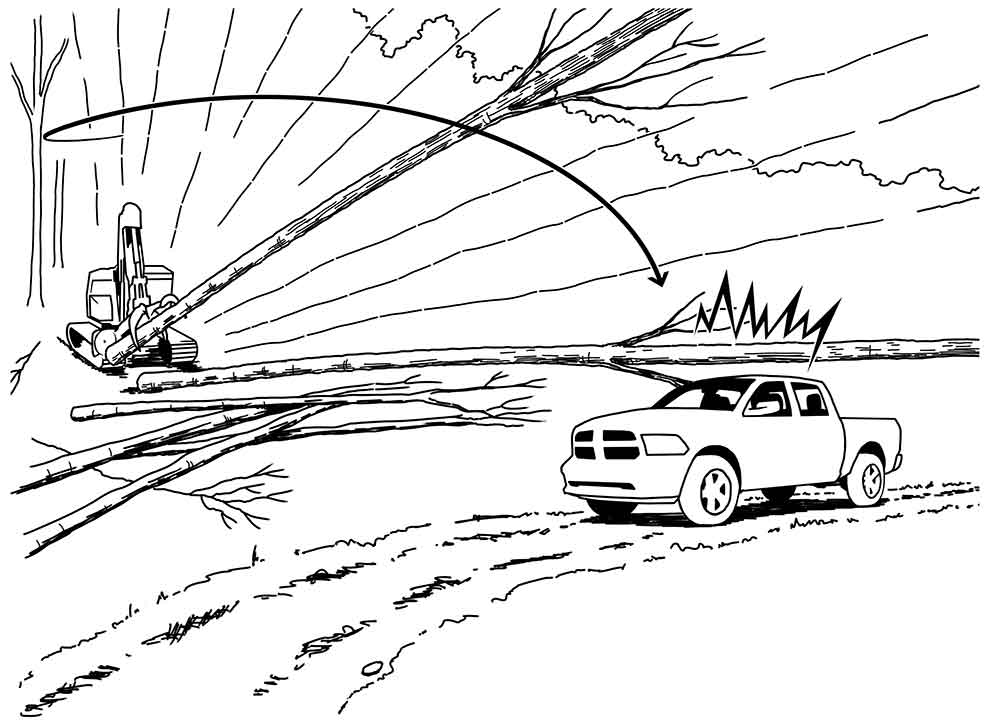
BACKGROUND: On a summer morning in the Southeastern U.S., a crew cab truck transporting three logging company employees was traveling to the deck to begin their shift. Conditions were clear that day and weather was not a contributing factor.
UNSAFE ACTS AND CONDITIONS: The tracked feller buncher operator was cutting alongside the haul road fully aware that additional crew members would be arriving soon to start their workday.
ACCIDENT: The employees in the company crew cab had traveled approximately four miles through the woods on the haul road en route to the deck. The crew cab stopped along the haul road before arriving at the deck to drop off the skidder driver close to his machine. The truck continued traveling to the deck where the loader and second skidder were located. Other crew members had arrived onsite approximately 45 minutes earlier and had already started their workday. The tracked feller buncher operator began cutting along the side of the haul road near the deck. The feller-buncher began cutting a 20-in. (DBH) gum tree measuring approximately 80 ft. in height. As the tree was being severed from the stump, the operator lost control of the tree and it started to fall back toward the machine. Instinctively, the operator used the cutter arm to push the tree away from the cab and toward the haul road. At the exact moment the operator was pushing the tree away from the feller-buncher, the crew cab truck was arriving at the deck. The felled tree struck the crew cab and came to rest on top of the truck. The feller-buncher operator alerted the other crew members and they assisted with removing the top of the tree from the cab.
INJURY: The crew extracted both employees from the crew cab truck and transported them to the intersection of the haul road and state highway to meet EMS personnel. The injured workers were transported to the local hospital where both were treated and released later in the day. One was diagnosed with a cervical fracture and referred to a neurosurgeon for further evaluation.
RECOMMENDATIONS:
- Always be aware of other crew members’ location, especially while conducting felling operations
- Properly assess the weight and balance of trees prior to felling to minimize accident risk
Supplied by Forest Resources Association
Latest News
Highland Pellets To Build $130 Million Facility In Arkansas
Highland Pellets LLC, an Arkansas company, today announced the building of a 500,000 metric ton per year wood pellet facility in Pine Bluff, Arkansas. The $130 million plant will create more than 35 direct jobs and an additional 482 indirect jobs with a direct...
North Carolina Wood Pellet Plants: Economic Growth vs. Environmental Effects
By the end of 2015, if all goes as expected, a forest the size of Fayetteville will be fed into two huge wood pellet plants to create energy for European industry. That much everyone agrees on. Whether it's a good thing remains a subject of debate. Loggers, forestry...
Southeast Could Become An Overdeveloped ‘Megalopolis’ In Next Half Century
Giant urban sprawl could pave over thousands of acres of Southeast forest and agricultural lands, connecting Raleigh to Atlanta by 2060, if growth continues at its current pace, according to a newly released research paper from the U.S. Geological Survey. “We could be...
Forest Health Experts Eye Hurricane Damage In N.C.’s Coastal Forests
For some residents of the North Carolina coast, the 2014 Independence Day weekend will be remembered not for fireworks and family cookouts, but for damage assessment and cleanup following the high winds and heavy rain that downed trees when Hurricane Arthur came...
Have A Question?
Send Us A Message