
Feller-Buncher Operator Breaks Power Line
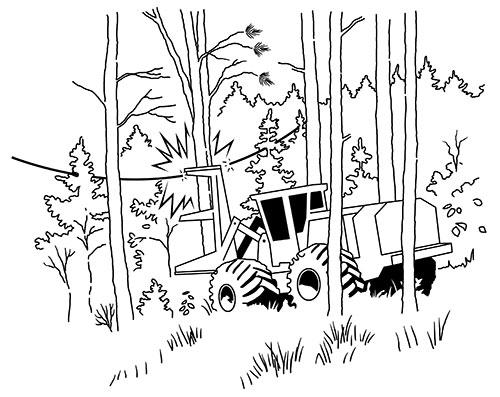 BACKGROUND: On a summer day in the South, a rubber-tired feller-buncher operator was performing a first thinning in a pine plantation. The feller-buncher was working in a new area of the stand, removing the take-down row and thinning the two rows on either side. The trees were approximately 15 years old, and there was a relatively thick layer of underbrush. The stand of timber surrounded the landowner’s home.
PERSONAL CHARACTERISTICS: The operator was in his mid-20s and had run feller-bunchers for about three years.
UNSAFE ACT AND CONDITIONS: The power company’s metered line ran from the pole-mounted transformer through the landowner’s maintained yard to the landowner’s home. A second metered line also ran from the transformer to a pole-mounted night light approximately 100 yards away on the bank of a small farm pond. The right-of-way to this second metered line was not maintained, and the line was completely obscured by the pine plantation and the thick underbrush and regrowth. Additionally, the line was only about 10 feet off the ground at its lowest point.
As the feller buncher was thinning, the operator did not see the power line ahead of the machine and continued cutting.
ACCIDENT: The head of the machine made contact with the line and pushed it forward far enough to cause an electric arc and break the line. After seeing the electrical arc and then the power line, the operator slowly backed the machine a safe distance away from the downed line.
INJURY: The operator was not injured.
RECOMMENDATIONS FOR CORRECTION:
- Harvest preplanning should include locating and marking all utilities.
- Close coordination with the landowner is essential when the harvest area includes dwellings, barns, septic systems, farm ponds, etc.
- Any unusual or dangerous areas or features of the harvest tract should be discussed and field-verified in advance with all machine operators to ensure operational safety.
- Whenever possible, maintain a safe operating distance of at least 50 feet (more for tall trees) from a power line for all harvesting activities.
Courtesy of the Forest Resources Association: forestresources.org
Latest News
Southeast Could Become An Overdeveloped ‘Megalopolis’ In Next Half Century
Giant urban sprawl could pave over thousands of acres of Southeast forest and agricultural lands, connecting Raleigh to Atlanta by 2060, if growth continues at its current pace, according to a newly released research paper from the U.S. Geological Survey. “We could be...
Forest Health Experts Eye Hurricane Damage In N.C.’s Coastal Forests
For some residents of the North Carolina coast, the 2014 Independence Day weekend will be remembered not for fireworks and family cookouts, but for damage assessment and cleanup following the high winds and heavy rain that downed trees when Hurricane Arthur came...
Have A Question?
Send Us A Message