
High Risk While Securing A Load
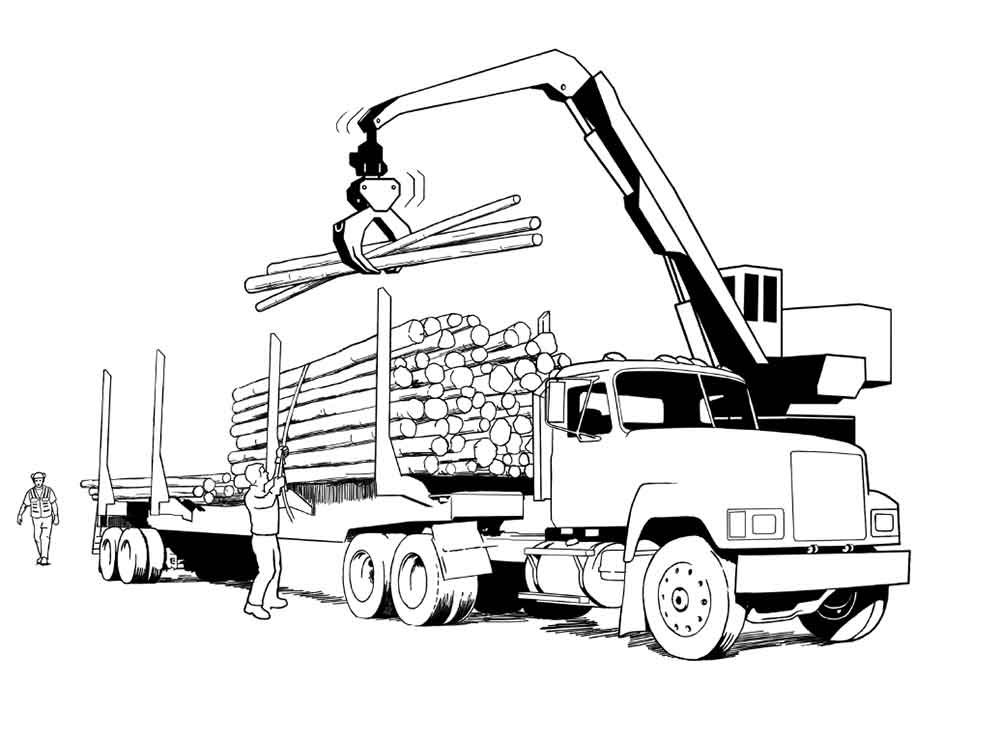
BACKGROUND: On a clear spring day in the Appalachians, a timber harvesting operation was actively working. The loader operator was engaged in loading a tractor-trailer with two bunks of 20′ pulpwood. The first bunk was loaded, and the loader operator began to load the second bunk.
PERSONAL CHARACTERISTICS: The loader operator was in his early 50s and had been working in the logging industry for over 30 years. The contracted truck driver was also in his 50s and had been hauling wood for several years. It is unknown what formal safety training either of the workers had.
UNSAFE ACT: The front bunk had been loaded, and the truck driver approached the truck on the far side of the trailer and began to unroll his tie-down straps. The loader operator could not see the driver and wasn’t aware that he had walked close to the trailer. The driver wasn’t wearing a hardhat or other safety equipment.
CLOSE CALL: The company forester, arriving on to the job, observed the situation. He saw the grapple, full of wood, carried high over the trailer while the driver was busy working on the opposite side. The forester moved quickly to get the loader operator’s attention and stopped the loading process. No accident occurred, but the situation presented a high risk. If the wood had slipped or a hydraulic line broke, there could have been a serious injury or fatality.
INJURY: None. The owner of the crew was grateful that the forester intervened.
RECOMMENDATIONS FOR CORRECTION:
- Always wear the proper PPE in the landing area and the woods.
- Never assume an operator knows where you are.
- Always make eye contact with the operator and communicate that it is safe to approach the area.
- Establish universal hand signals between crew members when voice commands can’t be heard.
- Always move the truck away from the loader and in a safe place before securing the load.
Supplied by Forest Resources Association
Latest News
USFS Southern Research Station Scientists Coordinate National Forest Assessment
A new U.S. Forest Service report provides updated national estimates of forest area, growth, mortality rate, and other information, including timber products output. Forest Service Southern Research Station (SRS) scientist Sonja Oswalt coordinated the assessment....
Texas A&M Aggies To Help Replant Trees At Bastrop State Park For Third Year
Hundreds of Aggies are once again heading to Bastrop State Park to help replenish trees lost during the devastating 2011 wildfire season—which destroyed an estimated 96 percent of the park. Approximately 550 Texas A&M University students, who are part of Aggie...
Have A Question?
Send Us A Message