
Log Truck Driver Loses Load On Access Ramp
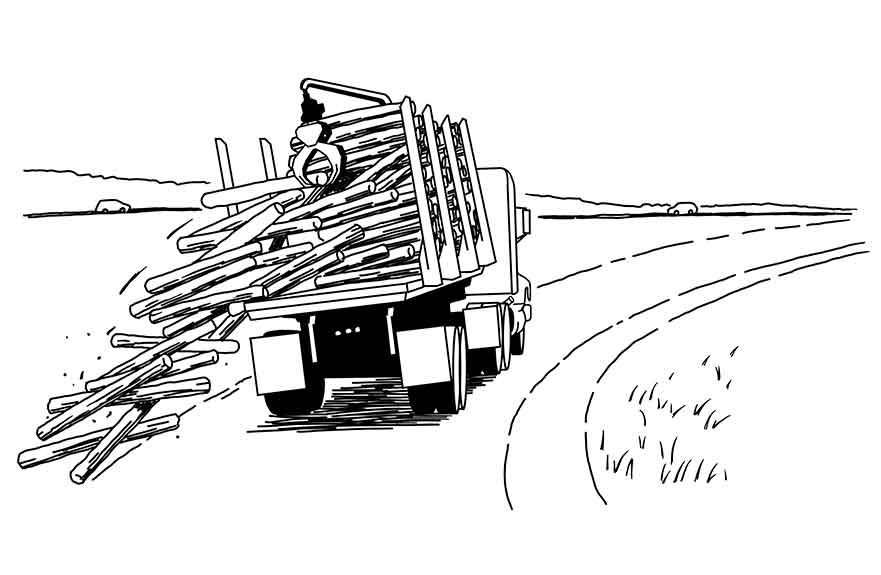
BACKGROUND: On a February afternoon in the Lake States Region, a log truck driver was hauling 100 in. pulpwood to a local mill.
The truck was equipped with a center mount grapple used to load and unload logs. It was a cold, sunny day, and the roads were free from ice and snow. Driving conditions were good.
PERSONAL CHARACTERISTICS: The log truck driver had more than 20 years of experience as a truck driver.
UNSAFE CONDITION: The truck driver was entering the access ramp onto the highway. The entrance ramp was slightly curved. The driver entered the turn at too high of a speed, and the load was not properly secured.
ACCIDENT: As the driver made the turn onto the ramp, the load of pulpwood logs shifted and spilled off the truck onto the pavement. This caused the access ramp to be closed for several hours as the logs were removed from the access ramp.
INJURY: No injuries were reported.
RECOMMENDATIONS:
- Drivers must follow posted speed limits and be aware of conditions they encounter.
- Use extreme caution when entering turns and cornering.
- Ensure loads are properly secured per Federal Regulations (49 CFR 393.116) when hauling shortwood logs crosswise.
- Logs must be solidly packed
- Each log not held in place by contact with other logs or the stakes, bunks or standards must be held in place by a tiedown. Additional tiedowns must be used when the condition of the wood results in low friction between logs.
- The end of a log in the lower tier cannot extend more than one-third of the log’s total length beyond the nearest supporting structure of the vehicle.
- When wood is loaded crosswise, it must be secured with at least two tiedowns.
- With the two tiedown requirement, they must be positioned at one-third and two-thirds of the length of the logs.
- Trailers more than 33-feet long must be equipped with center stakes and each tiedown must secure the highest log on each side of the center stake and must be fastened below these logs.
- Securement components must be built to withstand all anticipated operational forces without failure. Each of the logs on the top of the load must touch the tiedown. Each section of the load should be “rounded” to accomplish this so that each log below the top is subject to the downward force of the tightened tiedown.
Supplied by Forest Resources Association
Latest News
USDA Blog: The Building Blocks of Forest Restoration Partnerships
Is it possible to simultaneously promote natural resources conservation and the growth of businesses that impact the environment? Yes. One way to do so is through “compensatory mitigation.” Compensatory mitigation is the preservation, restoration and/or…
UT, Genera Energy Harvest Hybrid Poplar In Next Step Toward Bioeconomy
A small stand of poplar trees harvested from a University of Tennessee AgResearch Center is set to help scientists progress further down the path toward low-cost, high-quality biomass and a bioeconomy. Located on UT’s East…
New Website Highlights Economic Importance Of Forestry In The South
The Southern Regional Extension Forestry office (SREF) in partnership with the Southern Group of State Foresters (SGSF) has launched a one-stop website devoted to offering the most recent state and regional level data on forest…
Have A Question?
Send Us A Message