
Skidder Operator Cuts Leg When Topping Tree
 BACKGROUND:
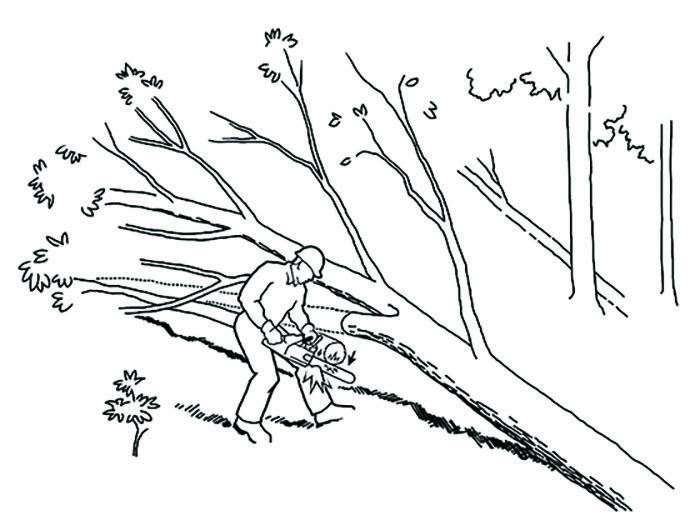
In the southeastern U.S., a logging crew was select cutting grade logs. Most trees were felled with a three-wheeled feller-buncher, but over-sized trees and timber in the SMZ’s were manually felled. One employee—the skidder operator—limbed and topped the felled timber.
PERSONAL CHARACTERISTICS:
The 40-year-old skidder operator/topper had 5 years of experience with other employers. He was considered an experienced chain saw operator, but was not wearing the required personal protective equipment.
UNSAFE ACT AND CONDITION:
He failed to put on his chaps before he topped the tree. He started to cut an 8-in. diameter, 15-ft. limb from the tree. The operator stood on the wrong (tension) side of the stem as he cut the limb and failed to recognize that this limb was under pressure.
ACCIDENT:
When he completed the cut, the tension (stored energy) of the limb was released, and the limb forcefully struck the chain saw. This forced the saw onto the operator’s left leg below the knee.
INJURY:
Since he did not wear chaps and he stood on the side of the limb that was under tension, the chain saw cut into his lower left leg, causing a severe laceration and chipping his shin bone. He required surgery to remove the bone fragments.
RECOMMENDATIONS FOR CORRECTION:
Employers must ensure that chain saw operators wear all personnel protective equipment. Chain saw operators must keep their bodies out of the danger zone. Operators can often position themselves to use the tree trunk as a shield against “loaded” limbs striking the legs. Use a limb-lock to prevent the sudden release of tension wood. Make the first cut on the side with compression pressure and the second cut on the side with tension, slightly offsetting and bypassing the first cut so that it creates a step in the limb which will prevent the limb from kicking back when it breaks.
Courtesy of the Forest Resources Association: forestresources.org
Latest News
Bioenergy Push Spurs Two New Wood Pellet Plants In Arkansas
Europe’s increasing emphasis on renewable energy lies behind the announcements this summer that two companies plan to build wood pellet plants in Arkansas, one in Pine Bluff and one in Monticello. Demand for the pellets,…
Opponents To N.C. State’s Hofmann Forest Sale Await Rulings
Opponents of N.C. State University’s planned sale of the 79,000-acre Hofmann Forest in Onslow and Jones counties still don’t have any indication when the state Court of Appeals will rule on whether the school will…
Have A Question?
Send Us A Message