
Unsecured Pulpwood Log Damages Truck Cab
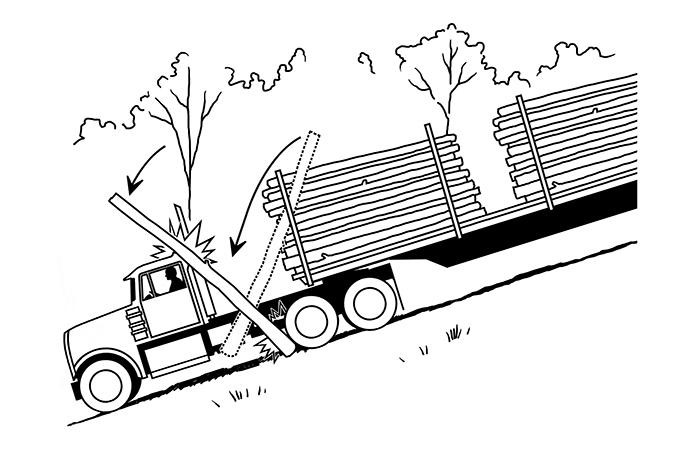 BACKGROUND:
On a clear, summer day in the Appalachians, a logging employee was driving (“spotting”) a load of logs from the log deck to a trailer drop site near the end of the woods road for pickup by a different truck. The road was dry and the terrain was rolling.
PERSONAL CHARACTERISTICS:
One of the work responsibilities of this employee was to use a chain saw to top hardwood timber at the log deck, trim the load on the trailer, and ferry the load and drop the trailer close to a hard-surface road. The 58-year-old employee had been working for this logging business for three years and had no known physical disabilities or previous accident history. He was wearing chaps, safety glasses, and a hard hat.
UNSAFE ACTS AND CONDITIONS:
The worker trimmed the load at the deck and then drove the load out to a drop area to be picked up later. He did not strap down the load because normally the “on the road” drivers strapped their own loads. Neither the log trailer nor the spot tractor (i.e., a truck that is not used on the highway) was equipped with a headache rack. The woods road was hilly.
ACCIDENT:
As the driver descended a small hill on the woods road, the top pulpwood log (a rough piece approximately 14 feet long and tapering from 14” down to 6” in diameter) on the front rack of wood slipped off the load and fell vertically down between the tires and the fuel tank. As the truck continued to move forward, the back tires of the tractor ran up on the log. This caused the log to slam forward and onto the top of the truck cab.
INJURY:
The log damaged the top of the cab and driver’s side door in such a way that the driver’s side door could not be opened. The driver was not injured, but he had to exit the truck from the passenger side and had to call for the skidder to dislodge the log.
RECOMMENDATIONS FOR CORRECTION:
• Move the loaded truck clear away from the log loading deck before trimming the load (or stop the loader if trimming the load at the deck) and secure the load before moving it to the drop site.
• Every driver must be responsible for ensuring that his load is properly secured before leaving the job, and the load should be rechecked before entering a public road.
• Every truck/tractor or log trailer should have a headache rack to guard against shifting logs.
Courtesy of the Forest Resources Association: forestresources.org
Latest News
Virginia Governor Announces Opening Of Agriculture, Forestry Trade Office In China
Virginia Gov. Bob McDonnell announced today as part of his trade and marketing mission to Asia the formal opening of a representative office in mainland China dedicated to increasing agricultural and forestry product exports to…
German Company To Open World’s Largest Wood Pellet Plant In Louisiana
The world’s largest wood pellet plant is coming to one of the smallest towns in Central Louisiana. German Pellets GmbH will begin work immediately on a $300 million plant in Urania that is expected to…
Have A Question?
Send Us A Message