FORISK’S Lang Paints Southern Forests Picture
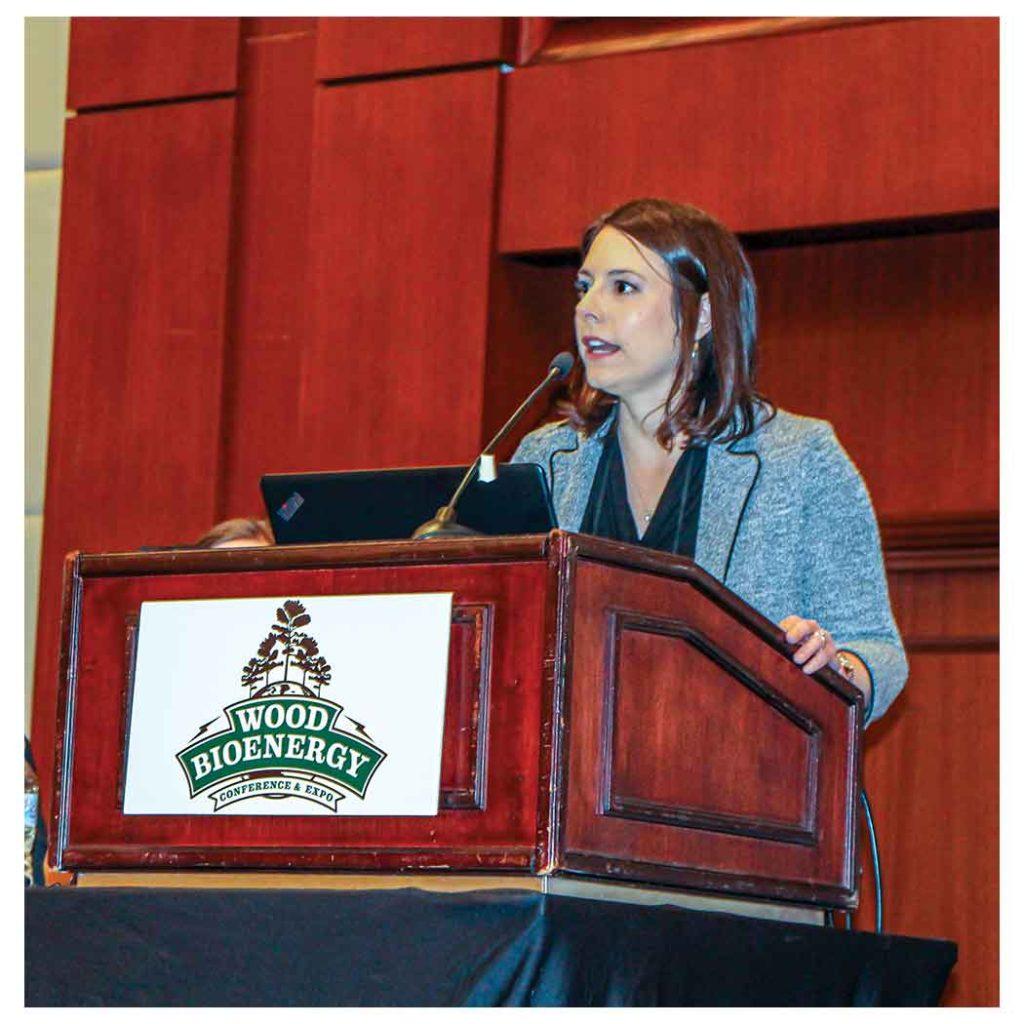 Amanda Hamsley Lang, COO & VP of Client Services with FORISK Consulting, addressed timber supply and outlook during the Wood Bioenergy Conference & Expo Held March 29-30 at the Omni Hotel at CNN Center in Atlanta.
Lang, who was one of the event keynoters, said that FORISK forecasts pine sawtimber inventories to increase through 2027 before declining through 2035 in the South. Deferred harvest during the Great Recession (2007-2009) along with improved genetics and silvicultural practices, which have increased timber growth rates by an average of 1% per acre per year for the past 10 years, lead pine sawtimber inventories to peak in 2027 at a level nearly 75% higher than in 2007 for the region. Lang added that the supply story varies across the region, with some states projecting continued increases in inventory while other states begin to see contraction much sooner depending on local market dynamics.
She added that decreased harvesting activity during the Great Recession resulted in fewer replanted forest acres, leading to a dip in the forest inventory for pulpwood-sized trees.
Lang said the average pine growth-to-drain ratio for the South in 2020 was 1.31, indicating a general oversupply of timber, though with tight markets in north Florida and south Georgia, and areas of coastal South Carolina and North Carolina, central Texas and Louisiana with relatively balanced timber supply and demand. She said northern Mississippi, Alabama and northeast Georgia show an oversupply of pine growth relative to demand.
But fast-forwarding five years to 2025, the timber supply becomes more balanced across the region, with an average pine growth-to-drain of 1.04, a period during which 10 sawmills and 11 pellet mills come on-line in the region.
Latest News
North Carolina State University’s Hofmann Forest Sale Nixed
The sale of a local, state owned forest will not continue as planned. North Carolina State University (NCSU) and the university’s board of trustees for their endowment fund announced in a release Friday the $150 million purchase agreement for the 79,000-acre Hofmann...
New Auburn University Study Shows Progress Towards Eradicating Cogongrass
Cogongrass is ranked as the seventh worst invasive plant species worldwide and is both a significant economic and ecological threat to much of Alabama and the Southeast. A new study reports significant progress in the fight against cogongrass. The report is published...
Have A Question?
Send Us A Message