
Lodged Tree Breaks Loose And Injures Timber Cutter
 BACKGROUND:
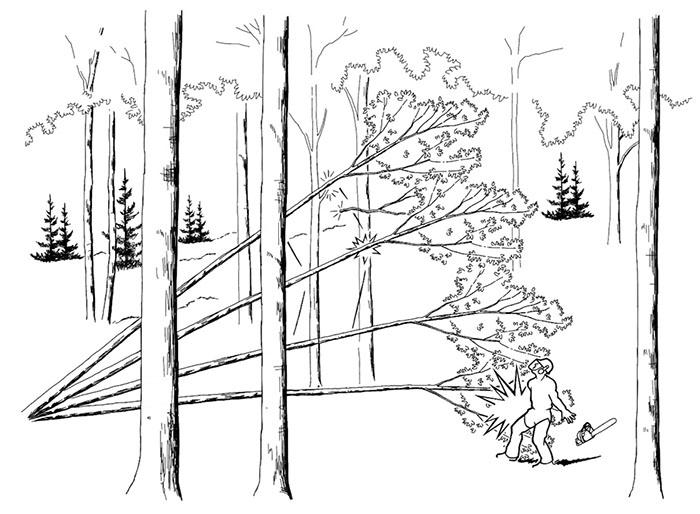
On a clear, dry, spring afternoon in the southeastern U.S., a logging crew was select cut thinning on a tract with mixed hardwoods and pines. The timber cutter had just manually felled an 18-inch poplar along a property line, but the tree became lodged at a point about 50 ft. high in another tree near the fence line.
PERSONAL CHARACTERISTICS:
The 48-year-old timber cutter had worked for his current logging employer for 21 years. He was considered a safe and well-trained cutter and had received chain saw training on directional felling techniques. He wore the appropriate personal protective equipment.
UNSAFE ACTS AND CONDITIONS:
The timber cutter walked away from the lodged tree to wait for the skidder to come and pull down the tree. He failed to move a safe distance (a minimum of “twice tree height”) away from the lodged tree. His escape route left him approximately 75 ft. away, at a right angle to the lean direction of the hung tree, rather than a safer 45º diagonally backward direction. He thought he was safe as there were several other trees between him and the lodged tree, but he was still within the danger zone of the lodged tree.
ACCIDENT:
Before the skidder arrived, he heard the tree snap and come loose from the snagged position. As the tree fell, it contacted another tree and fell towards the stumper. The top branch hit him and knocked him to the ground.
INJURY:
The impact of the branch broke two bones in his left leg. He lost seven months of work.
RECOMMENDATIONS FOR CORRECTION:
Make sure all on-the-ground workers move and stay at least “twice tree height” away from a lodged tree until it can be grounded by a skidder or other mechanical means. Ground personnel must always be aware of overhead hazards, including snags, dead branches, lodged trees and power lines. When manually felling trees, use a proper escape route—move a considerable distance diagonally backward from the direction of the tree fall. Continue to observe the falling tree during your retreat, remembering that even if the tree does not fall in your direction, limbs and tops can break free and be thrown in different directions.
Courtesy of the Forest Resources Association: forestresources.org
Latest News
Florida Forest Service Setting Prescribed Burns Ahead Of Wildfire Season
The heat’s been on in some state forests in Northeast Florida lately, despite the frigid temperatures of recent weeks. State forestry crews have been systematically burning dead underbrush in an effort to prevent wildfires over the next few months. The hazard...
Conservation Groups Oppose Bill To Allow Logging In West Virginia State Parks
A bill introduced last week that would allow commercial logging in West Virginia’s state parks as a way to pay for the park system’s backlogged maintenance work has prompted nine conservation groups to form a coalition opposing the bill’s passage. Senate Bill 270,...
Have A Question?
Send Us A Message