
Skidder On Highway After Dark Causes Vehicle Wreck
 BACKGROUND:
On a fall evening in the eastern U.S., an equipment operator was moving a skidder from one logging site to another using a public, two-lane highway. Although it was dark, he planned to drive the skidder a couple hundred yards down a straight, level stretch of the highway.
PERSONAL CHARACTERISTICS:
The equipment operator was a 23-year-old, short-term employee who had been told by his supervisor to move the skidder via the highway.
UNSAFE ACTS AND CONDITIONS:
After dark, the operator drove the skidder down a much-traveled highway with only the skidder lights in operation. There were four white lights facing forward and four white lights facing to the rear. No flashing amber lights and no escort vehicle or flagmen were used, and the skidder did not have a triangular (slow-moving vehicle) warning sign attached to it.
ACCIDENT:
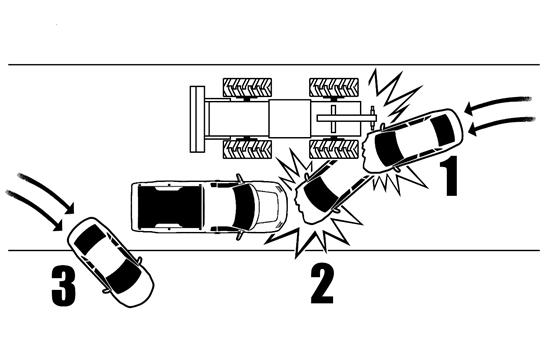
While proceeding down the highway, the slow-moving skidder was struck in the rear by a car traveling at 55 mph. The car then careened into a pickup truck coming from the opposite direction. A third vehicle, trying to avoid the collision, was forced into the roadside ditch.
INJURIES: The driver of the car was seriously injured, a passenger in the car was killed, and the driver of the pickup was seriously injured. The driver of the car that went into the ditch to avoid the collision was not injured, and neither was the skidder operator.
RECOMMENDATIONS FOR CORRECTION:
- It is never advisable to drive a skidder on a public highway, and especially not after dark. Don’t compromise safety just to save time.
- If you must operate an off-road machine for a short distance on a public road, always use a well-lighted escort vehicle and amber flashing lights to provide a warning, and a slow-moving vehicle triangular warning sign should always be attached to the equipment. Additional measures may be necessary. (Some states require a special permit or tag for running a mobile, off-road machine on a public road.)
- Supervisors should exercise management control when a hazardous situation exists for an inexperienced employee, and provide training where necessary. Employees should speak up and question directions if he/she believes the proposed action is unsafe.
Courtesy of the Forest Resources Association: forestresources.org
Latest News
Emerald Ash Borer Could Mean Trouble In Louisiana
A tiny insect from Asia has the potential to cause big problems for landowners and homeowners in Louisiana. The emerald ash borer was discovered recently in Webster Parish near Shongaloo, according to Wood Johnson, an entomologist with the U.S. Forest Service. It's...
Georgia May Ban LEED Certification For State Buildings
Georgia lawmakers are considering a bill that would effectively ban state buildings from being certified by LEED, a green building certification program. Rep. Mike Cheokas, R-Americus, is concerned because most lumber from Georgia isn’t considered sustainable by LEED....
Have A Question?
Send Us A Message